> For the complete documentation index, see [llms.txt](https://multx.litho.ai/llms.txt). Markdown versions of documentation pages are available by appending `.md` to page URLs; this page is available as [Markdown](https://multx.litho.ai/integrating-multx-for-cross-chain-governance-and-treasury-management.md).
# Integrating MultX for Cross-Chain Governance & Treasury Management
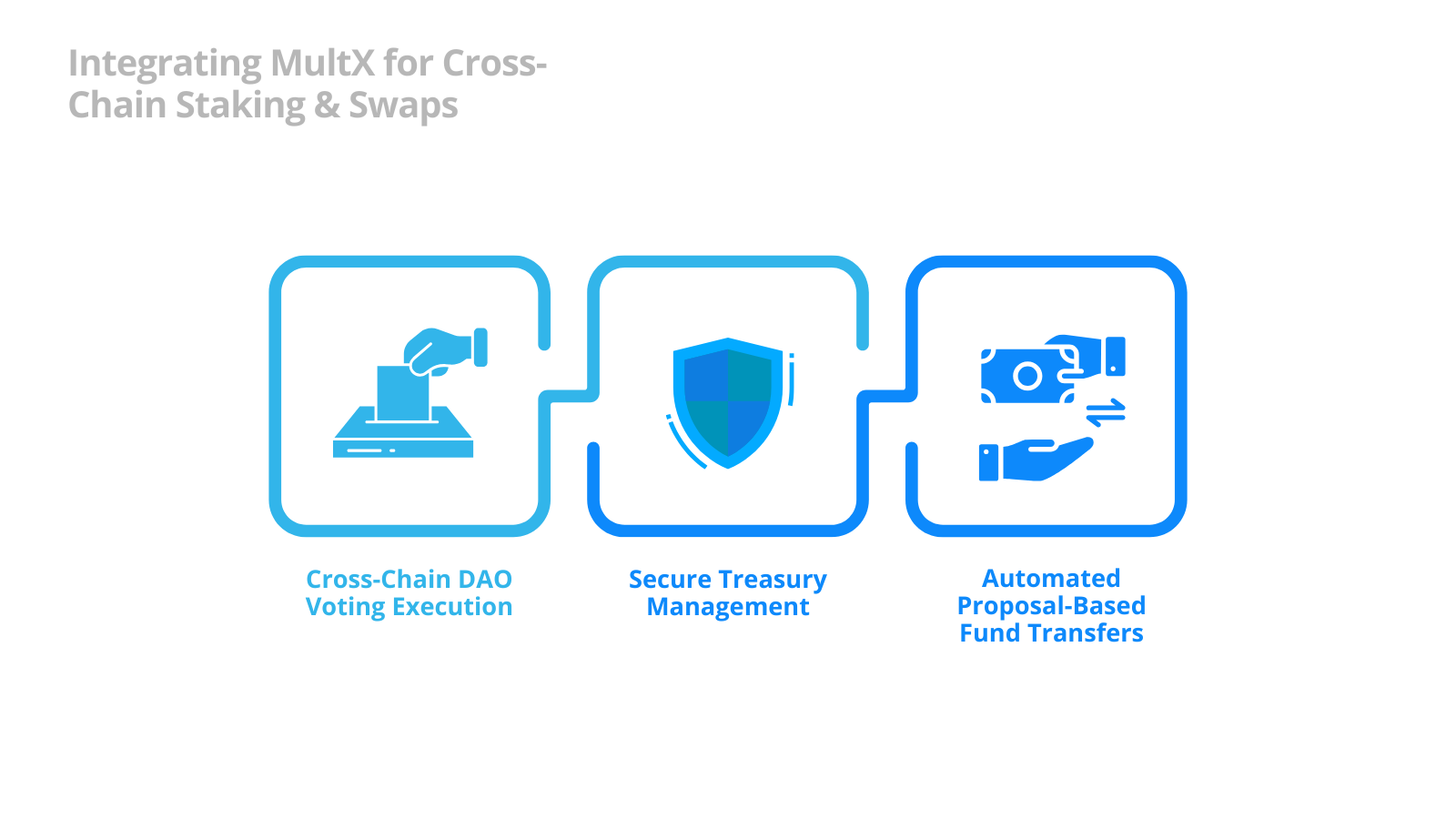 Based on the MultX protocol, it enables secure cross-chain token transfers using a multi-validator scheme. This can be leveraged for: ✅ Cross-Chain DAO Voting Execution\
✅ Secure Treasury Management\
✅ Automated Proposal-Based Fund Transfers
***
### 1. How MultX Works & Its Governance Application
#### MultX Protocol Flow (Simplified)
1. A user initiates a cross-chain transaction (sending tokens to a bridge contract).
2. 3 separate validators catch the event and independently sign it.
3. Once 2 out of 3 validators approve, the relayer executes the transaction on the destination chain.
4. The smart contract verifies signatures and processes the swap.
#### Use Case: Cross-Chain DAO Voting Execution
● Instead of token swaps, governance votes can be transferred across chains.
● Validators confirm votes and relay them securely.
● Final tally is aggregated on the main governance chain.
***
### 2. Implementing Cross-Chain DAO Voting with MultX
We modify our DAO Voting Contract to work with MultX Validators.
#### 2.1 Deploy Cross-Chain Voting Smart Contract
Modify CrossChainDAO.sol:
```solidity
// SPDX-License-Identifier: MIT
pragma solidity ^0.8.0;
import "@openzeppelin/contracts/access/Ownable.sol";
contract MultXCrossChainDAO is Ownable {
struct Proposal {
uint id;
string description;
uint yesVotes;
uint noVotes;
bool executed;
}
mapping(uint => Proposal) public proposals;
uint public proposalCount;
address public multxRelayer;
mapping(uint => mapping(address => bool)) public hasVoted;
event ProposalCreated(uint id, string description);
event VoteCast(uint id, address voter, bool support);
event ProposalExecuted(uint id);
constructor(address _multxRelayer) {
multxRelayer = _multxRelayer;
}
function createProposal(string memory description) public onlyOwner {
proposals[proposalCount] = Proposal(proposalCount, description, 0, 0, false);
emit ProposalCreated(proposalCount, description);
proposalCount++;
}
function vote(uint proposalId, bool support) public {
require(!hasVoted[proposalId][msg.sender], "Already voted");
Proposal storage proposal = proposals[proposalId];
if (support) {
proposal.yesVotes++;
} else {
proposal.noVotes++;
}
hasVoted[proposalId][msg.sender] = true;
emit VoteCast(proposalId, msg.sender, support);
}
function sendVoteToMultX(uint proposalId, bool support) public {
require(msg.sender == multxRelayer, "Only MultX relayer can call this");
vote(proposalId, support);
}
function executeProposal(uint proposalId) public {
Proposal storage proposal = proposals[proposalId];
require(!proposal.executed, "Already executed");
require(proposal.yesVotes > proposal.noVotes, "Not enough approvals");
proposal.executed = true;
emit ProposalExecuted(proposalId);
}
}
```
#### 2.2 MultX Validator Integration
Validators listen for DAO voting events and relay votes across chains.
**Modify the MultX Relayer Logic**
Instead of token transfers, MultX validators:
1. Monitor governance transactions.
2. Sign votes & forward them to the relayer.
3. The relayer calls sendVoteToMultX() on the target chain.
***
### 3. Secure Treasury Management with MultX
Treasury transactions must be multi-validated before execution.
#### 3.1 Deploy Multi-Sig DAO Treasury Contract
Modify DAOTreasury.sol:
```solidity
// SPDX-License-Identifier: MIT
pragma solidity ^0.8.0;
import "@openzeppelin/contracts/access/Ownable.sol";
contract MultXTreasury is Ownable {
struct Proposal {
uint id;
string description;
uint amount;
address payable recipient;
uint yesVotes;
uint noVotes;
bool executed;
}
Proposal[] public proposals;
mapping(uint => mapping(address => bool)) public hasVoted;
address public multxRelayer;
event ProposalCreated(uint id, string description, uint amount, address recipient);
event VoteCast(uint id, address voter, bool support);
event ProposalExecuted(uint id, address recipient, uint amount);
constructor(address _multxRelayer) {
multxRelayer = _multxRelayer;
}
function createProposal(string memory description, uint amount, address payable recipient) public onlyOwner {
require(address(this).balance >= amount, "Insufficient funds");
uint id = proposals.length;
proposals.push(Proposal(id, description, amount, recipient, 0, 0, false));
emit ProposalCreated(id, description, amount, recipient);
}
function vote(uint proposalId, bool support) public {
require(!hasVoted[proposalId][msg.sender], "Already voted");
Proposal storage proposal = proposals[proposalId];
if (support) {
proposal.yesVotes++;
} else {
proposal.noVotes++;
}
hasVoted[proposalId][msg.sender] = true;
emit VoteCast(proposalId, msg.sender, support);
}
function executeProposal(uint proposalId) public {
Proposal storage proposal = proposals[proposalId];
require(!proposal.executed, "Already executed");
require(proposal.yesVotes > proposal.noVotes, "Not enough approvals");
proposal.recipient.transfer(proposal.amount);
proposal.executed = true;
emit ProposalExecuted(proposalId, proposal.recipient, proposal.amount);
}
function sendTreasuryVoteToMultX(uint proposalId, bool support) public {
require(msg.sender == multxRelayer, "Only MultX relayer can call this");
vote(proposalId, support);
}
}
```
#### 3.2 How MultX Validators Work with Treasury
1. A DAO treasury vote is cast on BNB Chain.
2. MultX validators detect & verify signatures.
3. Relayer sends transaction to Ethereum/Polygon.
4. Final approval is executed on the chosen blockchain.
***
### 4. Integrating MultX in React Frontend
#### 4.1 Send Vote Requests to MultX
Modify App.js:
javascript
```javascript
const MULTX_RELAYER = "0xYourMultXRelayerContract";
const multxAbi = ["function sendVoteToMultX(uint proposalId, bool support) public"];
const sendVoteToMultX = async (proposalId, support) => {
const { signer } = await connectWallet();
const contract = new ethers.Contract(MULTX_RELAYER, multxAbi, signer);
await contract.sendVoteToMultX(proposalId, support);
toast.success(`Vote relayed via MultX for Proposal ${proposalId}!`);
};
```
#### 4.2 Modify UI for Cross-Chain Voting
jsx
```jsx
```
***
### 5. Features Implemented
✅ Cross-Chain DAO Voting with MultX (Secured by multi-validators).\
✅ Multi-Signature Treasury Management (Ensures DAO-controlled fund security).
***
### 6. Next Steps
🚀 Future Enhancements:
1. On-Chain Identity Verification (Prevent Sybil Attacks in DAO)
2. ZK-Rollup Governance (Private & Scalable Voting)
3. Tokenized Governance Rewards (Issue LITHO rewards based on activity)
Based on the MultX protocol, it enables secure cross-chain token transfers using a multi-validator scheme. This can be leveraged for: ✅ Cross-Chain DAO Voting Execution\
✅ Secure Treasury Management\
✅ Automated Proposal-Based Fund Transfers
***
### 1. How MultX Works & Its Governance Application
#### MultX Protocol Flow (Simplified)
1. A user initiates a cross-chain transaction (sending tokens to a bridge contract).
2. 3 separate validators catch the event and independently sign it.
3. Once 2 out of 3 validators approve, the relayer executes the transaction on the destination chain.
4. The smart contract verifies signatures and processes the swap.
#### Use Case: Cross-Chain DAO Voting Execution
● Instead of token swaps, governance votes can be transferred across chains.
● Validators confirm votes and relay them securely.
● Final tally is aggregated on the main governance chain.
***
### 2. Implementing Cross-Chain DAO Voting with MultX
We modify our DAO Voting Contract to work with MultX Validators.
#### 2.1 Deploy Cross-Chain Voting Smart Contract
Modify CrossChainDAO.sol:
```solidity
// SPDX-License-Identifier: MIT
pragma solidity ^0.8.0;
import "@openzeppelin/contracts/access/Ownable.sol";
contract MultXCrossChainDAO is Ownable {
struct Proposal {
uint id;
string description;
uint yesVotes;
uint noVotes;
bool executed;
}
mapping(uint => Proposal) public proposals;
uint public proposalCount;
address public multxRelayer;
mapping(uint => mapping(address => bool)) public hasVoted;
event ProposalCreated(uint id, string description);
event VoteCast(uint id, address voter, bool support);
event ProposalExecuted(uint id);
constructor(address _multxRelayer) {
multxRelayer = _multxRelayer;
}
function createProposal(string memory description) public onlyOwner {
proposals[proposalCount] = Proposal(proposalCount, description, 0, 0, false);
emit ProposalCreated(proposalCount, description);
proposalCount++;
}
function vote(uint proposalId, bool support) public {
require(!hasVoted[proposalId][msg.sender], "Already voted");
Proposal storage proposal = proposals[proposalId];
if (support) {
proposal.yesVotes++;
} else {
proposal.noVotes++;
}
hasVoted[proposalId][msg.sender] = true;
emit VoteCast(proposalId, msg.sender, support);
}
function sendVoteToMultX(uint proposalId, bool support) public {
require(msg.sender == multxRelayer, "Only MultX relayer can call this");
vote(proposalId, support);
}
function executeProposal(uint proposalId) public {
Proposal storage proposal = proposals[proposalId];
require(!proposal.executed, "Already executed");
require(proposal.yesVotes > proposal.noVotes, "Not enough approvals");
proposal.executed = true;
emit ProposalExecuted(proposalId);
}
}
```
#### 2.2 MultX Validator Integration
Validators listen for DAO voting events and relay votes across chains.
**Modify the MultX Relayer Logic**
Instead of token transfers, MultX validators:
1. Monitor governance transactions.
2. Sign votes & forward them to the relayer.
3. The relayer calls sendVoteToMultX() on the target chain.
***
### 3. Secure Treasury Management with MultX
Treasury transactions must be multi-validated before execution.
#### 3.1 Deploy Multi-Sig DAO Treasury Contract
Modify DAOTreasury.sol:
```solidity
// SPDX-License-Identifier: MIT
pragma solidity ^0.8.0;
import "@openzeppelin/contracts/access/Ownable.sol";
contract MultXTreasury is Ownable {
struct Proposal {
uint id;
string description;
uint amount;
address payable recipient;
uint yesVotes;
uint noVotes;
bool executed;
}
Proposal[] public proposals;
mapping(uint => mapping(address => bool)) public hasVoted;
address public multxRelayer;
event ProposalCreated(uint id, string description, uint amount, address recipient);
event VoteCast(uint id, address voter, bool support);
event ProposalExecuted(uint id, address recipient, uint amount);
constructor(address _multxRelayer) {
multxRelayer = _multxRelayer;
}
function createProposal(string memory description, uint amount, address payable recipient) public onlyOwner {
require(address(this).balance >= amount, "Insufficient funds");
uint id = proposals.length;
proposals.push(Proposal(id, description, amount, recipient, 0, 0, false));
emit ProposalCreated(id, description, amount, recipient);
}
function vote(uint proposalId, bool support) public {
require(!hasVoted[proposalId][msg.sender], "Already voted");
Proposal storage proposal = proposals[proposalId];
if (support) {
proposal.yesVotes++;
} else {
proposal.noVotes++;
}
hasVoted[proposalId][msg.sender] = true;
emit VoteCast(proposalId, msg.sender, support);
}
function executeProposal(uint proposalId) public {
Proposal storage proposal = proposals[proposalId];
require(!proposal.executed, "Already executed");
require(proposal.yesVotes > proposal.noVotes, "Not enough approvals");
proposal.recipient.transfer(proposal.amount);
proposal.executed = true;
emit ProposalExecuted(proposalId, proposal.recipient, proposal.amount);
}
function sendTreasuryVoteToMultX(uint proposalId, bool support) public {
require(msg.sender == multxRelayer, "Only MultX relayer can call this");
vote(proposalId, support);
}
}
```
#### 3.2 How MultX Validators Work with Treasury
1. A DAO treasury vote is cast on BNB Chain.
2. MultX validators detect & verify signatures.
3. Relayer sends transaction to Ethereum/Polygon.
4. Final approval is executed on the chosen blockchain.
***
### 4. Integrating MultX in React Frontend
#### 4.1 Send Vote Requests to MultX
Modify App.js:
javascript
```javascript
const MULTX_RELAYER = "0xYourMultXRelayerContract";
const multxAbi = ["function sendVoteToMultX(uint proposalId, bool support) public"];
const sendVoteToMultX = async (proposalId, support) => {
const { signer } = await connectWallet();
const contract = new ethers.Contract(MULTX_RELAYER, multxAbi, signer);
await contract.sendVoteToMultX(proposalId, support);
toast.success(`Vote relayed via MultX for Proposal ${proposalId}!`);
};
```
#### 4.2 Modify UI for Cross-Chain Voting
jsx
```jsx
```
***
### 5. Features Implemented
✅ Cross-Chain DAO Voting with MultX (Secured by multi-validators).\
✅ Multi-Signature Treasury Management (Ensures DAO-controlled fund security).
***
### 6. Next Steps
🚀 Future Enhancements:
1. On-Chain Identity Verification (Prevent Sybil Attacks in DAO)
2. ZK-Rollup Governance (Private & Scalable Voting)
3. Tokenized Governance Rewards (Issue LITHO rewards based on activity)