# Multx Protocol
A Decentralized Cross-Chain Protocol on the Lithosphere (LITHO) Network
{% content-ref url="/pages/Sfn3e8zkAnNg6h5Me3Sk" %}
[Abstract](/abstract)
{% endcontent-ref %}
{% content-ref url="/pages/wZnpDfXgvgo9vjrxlJgN" %}
[Introduction](/introduction)
{% endcontent-ref %}
{% content-ref url="/pages/a2dbCfEeBuRCU5RKOv8J" %}
[How Multx Works](/how-multx-works)
{% endcontent-ref %}
{% content-ref url="/pages/v0WcxDqqaMExM0ocfa8M" %}
[System Components](/system-components)
{% endcontent-ref %}
{% content-ref url="/pages/FAIGMnHMd317EuJjZK6L" %}
[Integrating MultX for Cross-Chain Governance & Treasury Management](/integrating-multx-for-cross-chain-governance-and-treasury-management)
{% endcontent-ref %}
{% content-ref url="/pages/kIeHb4QDs3NcwcGsuiFI" %}
[Integrating MultX for Cross-Chain Staking & Swaps](/integrating-multx-for-cross-chain-staking-and-swaps)
{% endcontent-ref %}
{% content-ref url="/pages/SJd2Edpl1LNBFcrA52RL" %}
[Security Mechanisms](/security-mechanisms)
{% endcontent-ref %}
{% content-ref url="/pages/LhjiaKFbzuYeECGc7P1N" %}
[Scalability and Future Directions](/scalability-and-future-directions)
{% endcontent-ref %}
{% content-ref url="/pages/RbsOLnBIHhFcm6fzfYoc" %}
[Conclusion](/conclusion)
{% endcontent-ref %}
# Abstract
Created by Lithosphere founder and Chief Architect [King Kasr](https://kasr.me), Multx is a decentralized protocol developed on the Lithosphere (LITHO) network, designed to enable seamless token transfers across multiple blockchain networks. Leveraging a multi-validator model, Multx ensures secure and efficient cross-chain token swaps with minimal user intervention. This whitepaper outlines the key components, processes, and security mechanisms underpinning the Multx protocol.
# Introduction
The blockchain ecosystem remains highly segmented, with individual networks offering unique capabilities. As decentralized finance (DeFi) adoption grows, so does the need for interoperability among these networks. **Multx** addresses this challenge by facilitating cross-chain token swaps via a trustless, multi-validator mechanism. With Multx, users can transfer tokens from one blockchain to another while maintaining network security and avoiding single points of failure.
# How Multx Works
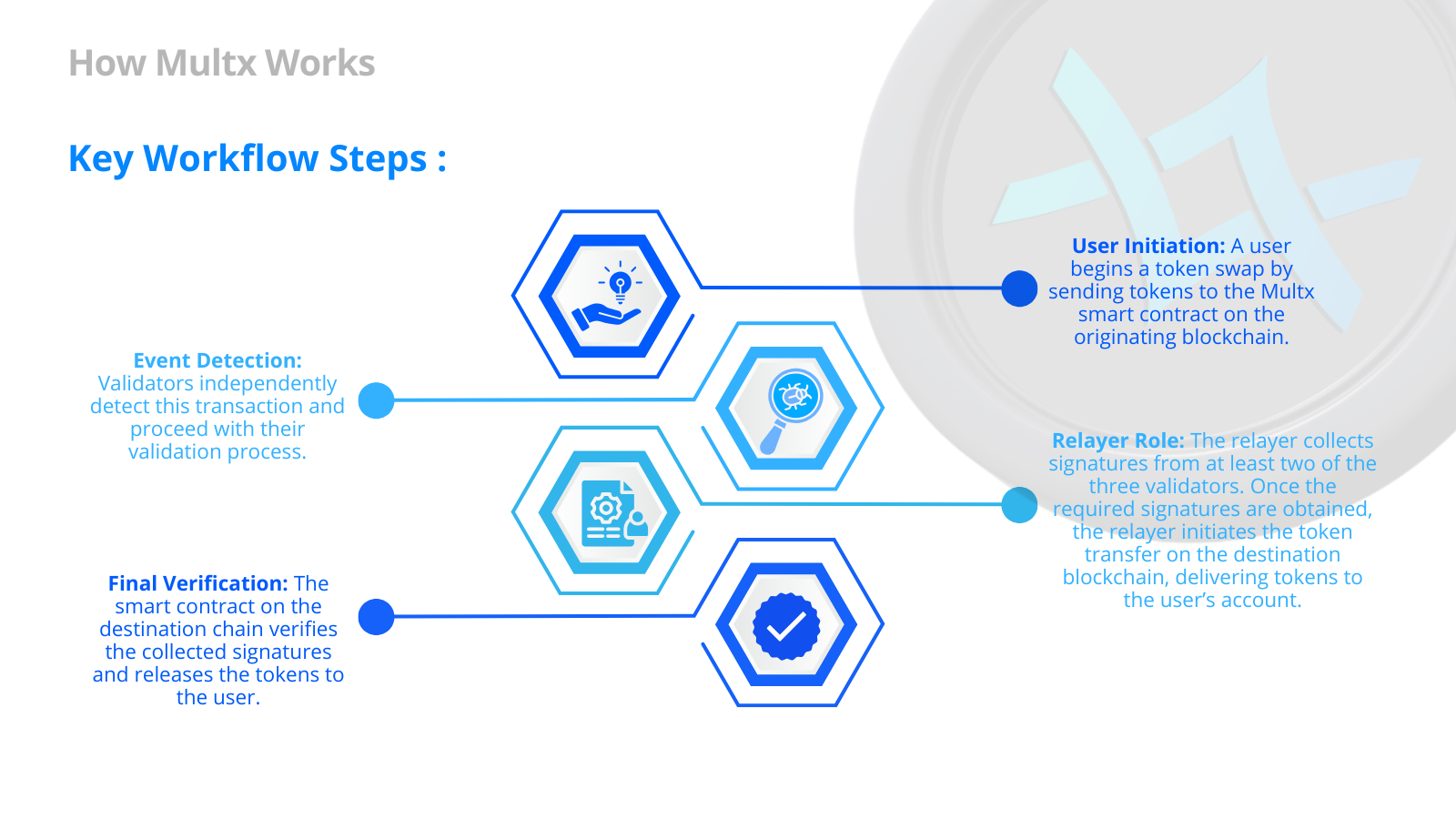
Multx operates on a decentralized multi-validator architecture where each validator functions independently. When a user initiates a token swap, validators on the Multx network observe and validate transactions across blockchains without direct interaction.
#### **Key Workflow Steps**
1. **User Initiation:** A user begins a token swap by sending tokens to the Multx smart contract on the originating blockchain.
2. **Event Detection:** Validators independently detect this transaction and proceed with their validation process.
3. **Relayer Role:** The relayer collects signatures from at least two of the three validators. Once the required signatures are obtained, the relayer initiates the token transfer on the destination blockchain, delivering tokens to the user’s account.
4. **Final Verification:** The smart contract on the destination chain verifies the collected signatures and releases the tokens to the user.
# Integrating MultX for Cross-Chain Governance & Treasury Management
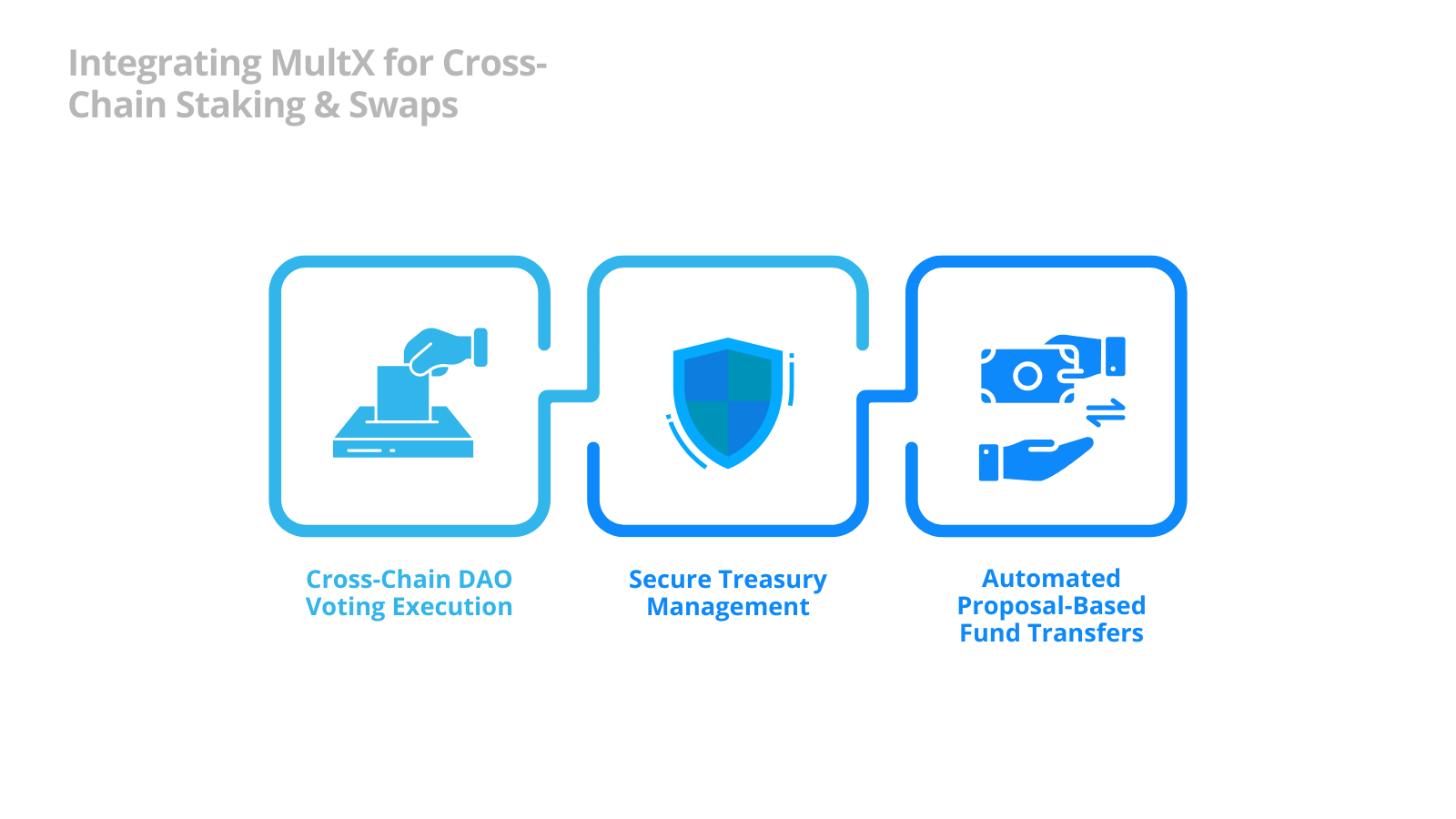
Based on the MultX protocol, it enables secure cross-chain token transfers using a multi-validator scheme. This can be leveraged for: ✅ Cross-Chain DAO Voting Execution\
✅ Secure Treasury Management\
✅ Automated Proposal-Based Fund Transfers
***
### 1. How MultX Works & Its Governance Application
#### MultX Protocol Flow (Simplified)
1. A user initiates a cross-chain transaction (sending tokens to a bridge contract).
2. 3 separate validators catch the event and independently sign it.
3. Once 2 out of 3 validators approve, the relayer executes the transaction on the destination chain.
4. The smart contract verifies signatures and processes the swap.
#### Use Case: Cross-Chain DAO Voting Execution
● Instead of token swaps, governance votes can be transferred across chains.
● Validators confirm votes and relay them securely.
● Final tally is aggregated on the main governance chain.
***
### 2. Implementing Cross-Chain DAO Voting with MultX
We modify our DAO Voting Contract to work with MultX Validators.
#### 2.1 Deploy Cross-Chain Voting Smart Contract
Modify CrossChainDAO.sol:
```solidity
// SPDX-License-Identifier: MIT
pragma solidity ^0.8.0;
import "@openzeppelin/contracts/access/Ownable.sol";
contract MultXCrossChainDAO is Ownable {
struct Proposal {
uint id;
string description;
uint yesVotes;
uint noVotes;
bool executed;
}
mapping(uint => Proposal) public proposals;
uint public proposalCount;
address public multxRelayer;
mapping(uint => mapping(address => bool)) public hasVoted;
event ProposalCreated(uint id, string description);
event VoteCast(uint id, address voter, bool support);
event ProposalExecuted(uint id);
constructor(address _multxRelayer) {
multxRelayer = _multxRelayer;
}
function createProposal(string memory description) public onlyOwner {
proposals[proposalCount] = Proposal(proposalCount, description, 0, 0, false);
emit ProposalCreated(proposalCount, description);
proposalCount++;
}
function vote(uint proposalId, bool support) public {
require(!hasVoted[proposalId][msg.sender], "Already voted");
Proposal storage proposal = proposals[proposalId];
if (support) {
proposal.yesVotes++;
} else {
proposal.noVotes++;
}
hasVoted[proposalId][msg.sender] = true;
emit VoteCast(proposalId, msg.sender, support);
}
function sendVoteToMultX(uint proposalId, bool support) public {
require(msg.sender == multxRelayer, "Only MultX relayer can call this");
vote(proposalId, support);
}
function executeProposal(uint proposalId) public {
Proposal storage proposal = proposals[proposalId];
require(!proposal.executed, "Already executed");
require(proposal.yesVotes > proposal.noVotes, "Not enough approvals");
proposal.executed = true;
emit ProposalExecuted(proposalId);
}
}
```
#### 2.2 MultX Validator Integration
Validators listen for DAO voting events and relay votes across chains.
**Modify the MultX Relayer Logic**
Instead of token transfers, MultX validators:
1. Monitor governance transactions.
2. Sign votes & forward them to the relayer.
3. The relayer calls sendVoteToMultX() on the target chain.
***
### 3. Secure Treasury Management with MultX
Treasury transactions must be multi-validated before execution.
#### 3.1 Deploy Multi-Sig DAO Treasury Contract
Modify DAOTreasury.sol:
```solidity
// SPDX-License-Identifier: MIT
pragma solidity ^0.8.0;
import "@openzeppelin/contracts/access/Ownable.sol";
contract MultXTreasury is Ownable {
struct Proposal {
uint id;
string description;
uint amount;
address payable recipient;
uint yesVotes;
uint noVotes;
bool executed;
}
Proposal[] public proposals;
mapping(uint => mapping(address => bool)) public hasVoted;
address public multxRelayer;
event ProposalCreated(uint id, string description, uint amount, address recipient);
event VoteCast(uint id, address voter, bool support);
event ProposalExecuted(uint id, address recipient, uint amount);
constructor(address _multxRelayer) {
multxRelayer = _multxRelayer;
}
function createProposal(string memory description, uint amount, address payable recipient) public onlyOwner {
require(address(this).balance >= amount, "Insufficient funds");
uint id = proposals.length;
proposals.push(Proposal(id, description, amount, recipient, 0, 0, false));
emit ProposalCreated(id, description, amount, recipient);
}
function vote(uint proposalId, bool support) public {
require(!hasVoted[proposalId][msg.sender], "Already voted");
Proposal storage proposal = proposals[proposalId];
if (support) {
proposal.yesVotes++;
} else {
proposal.noVotes++;
}
hasVoted[proposalId][msg.sender] = true;
emit VoteCast(proposalId, msg.sender, support);
}
function executeProposal(uint proposalId) public {
Proposal storage proposal = proposals[proposalId];
require(!proposal.executed, "Already executed");
require(proposal.yesVotes > proposal.noVotes, "Not enough approvals");
proposal.recipient.transfer(proposal.amount);
proposal.executed = true;
emit ProposalExecuted(proposalId, proposal.recipient, proposal.amount);
}
function sendTreasuryVoteToMultX(uint proposalId, bool support) public {
require(msg.sender == multxRelayer, "Only MultX relayer can call this");
vote(proposalId, support);
}
}
```
#### 3.2 How MultX Validators Work with Treasury
1. A DAO treasury vote is cast on BNB Chain.
2. MultX validators detect & verify signatures.
3. Relayer sends transaction to Ethereum/Polygon.
4. Final approval is executed on the chosen blockchain.
***
### 4. Integrating MultX in React Frontend
#### 4.1 Send Vote Requests to MultX
Modify App.js:
javascript
```javascript
const MULTX_RELAYER = "0xYourMultXRelayerContract";
const multxAbi = ["function sendVoteToMultX(uint proposalId, bool support) public"];
const sendVoteToMultX = async (proposalId, support) => {
const { signer } = await connectWallet();
const contract = new ethers.Contract(MULTX_RELAYER, multxAbi, signer);
await contract.sendVoteToMultX(proposalId, support);
toast.success(`Vote relayed via MultX for Proposal ${proposalId}!`);
};
```
#### 4.2 Modify UI for Cross-Chain Voting
jsx
```jsx
```
***
### 5. Features Implemented
✅ Cross-Chain DAO Voting with MultX (Secured by multi-validators).\
✅ Multi-Signature Treasury Management (Ensures DAO-controlled fund security).
***
### 6. Next Steps
🚀 Future Enhancements:
1. On-Chain Identity Verification (Prevent Sybil Attacks in DAO)
2. ZK-Rollup Governance (Private & Scalable Voting)
3. Tokenized Governance Rewards (Issue LITHO rewards based on activity)
# Integrating MultX for Cross-Chain Staking & Swaps
Now, we’ll enhance the LITHO MultX Protocol with:\
✅ Cross-Chain Staking (Stake LITHO on One Chain, Earn Rewards on Another)\
✅ Cross-Chain Token Swaps (Bridge LITHO & Other Tokens Securely)
***
### 1. How MultX Facilitates Cross-Chain Staking & Swaps
MultX uses multi-validator schemes to securely process transactions across chains.
#### Cross-Chain Staking Flow
1. User stakes LITHO on Blockchain A.
2. Validators detect and verify the staking event.
3. Relayer forwards staking proof to Blockchain B.
4. Staker earns rewards on Blockchain B.
#### Cross-Chain Swap Flow
1. User sends tokens to a bridge contract on Blockchain A.
2. Validators independently sign and approve the transaction.
3. Once 2 out of 3 validators confirm, relayer executes the transaction on Blockchain B.
4. User receives the equivalent token on Blockchain B.
***
### 2. Implementing Cross-Chain Staking with MultX
We will create a staking contract that:
● Accepts LITHO tokens on one chain.
● Sends staking proof via MultX.
● Rewards the user on another chain.
#### 2.1 Deploy the Staking Smart Contract
**CrossChainStaking.sol**
Solidity
```solidity
// SPDX-License-Identifier: MIT
pragma solidity ^0.8.0;
import "@openzeppelin/contracts/token/ERC20/IERC20.sol";
contract CrossChainStaking {
IERC20 public lithoToken;
address public multxRelayer;
mapping(address => uint256) public stakedAmount;
mapping(address => uint256) public rewardAmount;
event Staked(address indexed user, uint256 amount);
event RewardsUpdated(address indexed user, uint256 reward);
event Claimed(address indexed user, uint256 amount);
constructor(address _lithoToken, address _multxRelayer) {
lithoToken = IERC20(_lithoToken);
multxRelayer = _multxRelayer;
}
function stake(uint256 amount) public {
require(amount > 0, "Amount must be greater than zero");
lithoToken.transferFrom(msg.sender, address(this), amount);
stakedAmount[msg.sender] += amount;
emit Staked(msg.sender, amount);
// Send staking data to MultX relayer for cross-chain processing
(bool success, ) = multxRelayer.call(abi.encodeWithSignature("sendStakingData(address,uint256)", msg.sender, amount));
require(success, "MultX relayer failed");
}
function updateRewards(address user, uint256 reward) public {
require(msg.sender == multxRelayer, "Only MultX relayer can call this");
rewardAmount[user] += reward;
emit RewardsUpdated(user, reward);
}
function claimRewards() public {
uint256 reward = rewardAmount[msg.sender];
require(reward > 0, "No rewards available");
rewardAmount[msg.sender] = 0;
lithoToken.transfer(msg.sender, reward);
emit Claimed(msg.sender, reward);
}
}
```
***
#### 2.2 MultX Validator Role in Cross-Chain Staking
MultX validators listen for staking events, sign them, and relay the event to the destination chain.
**Modify the MultX Relayer Logic**
Instead of swapping tokens, MultX validators:
1. Monitor staking events.
2. Sign staking transactions & forward them to the relayer.
3. Relayer executes rewards distribution on Blockchain B.
***
#### 2.3 Integrate Cross-Chain Staking in React
Modify App.js to interact with the staking contract.
**Update App.js to Handle Staking**
javascript
```javascript
const STAKING_CONTRACT = "0xYourStakingContract";
const stakingAbi = [
"function stake(uint256 amount) public",
"function claimRewards() public",
"function rewardAmount(address user) public view returns (uint256)"
];
const [stakedAmount, setStakedAmount] = useState(0);
const [rewards, setRewards] = useState(0);
const checkRewards = async () => {
const { provider, signer } = await connectWallet();
const contract = new ethers.Contract(STAKING_CONTRACT, stakingAbi, provider);
const reward = await contract.rewardAmount(signer.getAddress());
setRewards(ethers.utils.formatEther(reward));
};
const stakeTokens = async (amount) => {
const { signer } = await connectWallet();
const contract = new ethers.Contract(STAKING_CONTRACT, stakingAbi, signer);
await contract.stake(amount);
toast.success(`Staked ${amount} LITHO!`);
};
```
**Modify UI to Show Staking & Rewards**
jsx
```jsx
setStakedAmount(e.target.value)} />
Your Staking Rewards: {rewards} LITHO
```
***
### 3. Implementing Cross-Chain Token Swaps with MultX
MultX will facilitate secure token swaps between chains.
#### 3.1 Deploy Cross-Chain Swap Smart Contract
**CrossChainSwap.sol**
solidity
```solidity
// SPDX-License-Identifier: MIT
pragma solidity ^0.8.0;
import "@openzeppelin/contracts/token/ERC20/IERC20.sol";
contract CrossChainSwap {
IERC20 public tokenA;
IERC20 public tokenB;
address public multxRelayer;
event SwapInitiated(address indexed user, uint256 amount, address destination);
event SwapCompleted(address indexed user, uint256 amount);
constructor(address _tokenA, address _tokenB, address _multxRelayer) {
tokenA = IERC20(_tokenA);
tokenB = IERC20(_tokenB);
multxRelayer = _multxRelayer;
}
function initiateSwap(uint256 amount, address destination) public {
require(amount > 0, "Amount must be greater than zero");
tokenA.transferFrom(msg.sender, address(this), amount);
emit SwapInitiated(msg.sender, amount, destination);
// Send swap data to MultX relayer
(bool success, ) = multxRelayer.call(abi.encodeWithSignature("sendSwapData(address,uint256,address)", msg.sender, amount, destination));
require(success, "MultX relayer failed");
}
function completeSwap(address user, uint256 amount) public {
require(msg.sender == multxRelayer, "Only MultX relayer can call this");
tokenB.transfer(user, amount);
emit SwapCompleted(user, amount);
}
}
```
***
#### 3.2 Modify MultX Validators for Token Swaps
MultX validators will:
1. Monitor token swap transactions.
2. Verify swap signatures.
3. Execute swaps across chains.
***
#### 3.3 Integrate Cross-Chain Swaps in React
**Modify App.js to Handle Swaps**
javascript
```javascript
const SWAP_CONTRACT = "0xYourSwapContract";
const swapAbi = [
"function initiateSwap(uint256 amount, address destination) public",
"function completeSwap(address user, uint256 amount) public"
];
const swapTokens = async (amount, destination) => {
const { signer } = await connectWallet();
const contract = new ethers.Contract(SWAP_CONTRACT, swapAbi, signer);
await contract.initiateSwap(amount, destination);
toast.success(`Swap initiated for ${amount} tokens to ${destination}`);
};
```
**Modify UI for Swaps**
jsx
```jsx
setStakedAmount(e.target.value)} />
setRecipient(e.target.value)} />
```
***
### 4. Features Implemented
✅ Cross-Chain Staking with MultX (Stake on one chain, earn rewards on another).\
✅ Cross-Chain Swaps with MultX (Secure multi-validator token swaps).
***
### 5. Next Steps
🚀 Future Enhancements:
1. Yield Farming via MultX Staking
2. AI-Powered Swap Optimization (Best Route for Cross-Chain Swaps)
3. Liquidity Pool Staking (Stake LP Tokens for Higher Rewards)
#### Implementing Yield Farming via MultX Staking & AI-Powered Swap Optimization
Now, we’ll enhance the LITHO MultX Protocol with:\
✅ Yield Farming via MultX Staking (Stake LITHO or LP tokens and earn rewards across chains).\
✅ AI-Powered Swap Optimization (Choose the best route for cross-chain swaps).
***
### 1. Yield Farming via MultX Staking
#### 1.1 Overview
● Users stake LITHO or LP tokens across different chains.
● MultX relayer processes transactions securely.
● Automated reward distribution via staking contract.
***
#### 1.2 Deploy Yield Farming Smart Contract
Modify CrossChainYieldFarming.sol:
solidity
// SPDX-License-Identifier: MIT
pragma solidity ^0.8.0;

import "@openzeppelin/contracts/token/ERC20/IERC20.sol";

contract CrossChainYieldFarming {
    IERC20 public stakingToken;
    IERC20 public rewardToken;
    address public multxRelayer;
    uint public rewardRate;

    mapping(address => uint) public stakedBalance;
    mapping(address => uint) public lastUpdate;
    mapping(address => uint) public rewards;

    event Staked(address indexed user, uint256 amount);
    event Withdrawn(address indexed user, uint256 amount);
    event RewardsClaimed(address indexed user, uint256 amount);

    constructor(address _stakingToken, address _rewardToken, address _multxRelayer, uint _rewardRate) {
        stakingToken = IERC20(_stakingToken);
        rewardToken = IERC20(_rewardToken);
        multxRelayer = _multxRelayer;
        rewardRate = _rewardRate;
    }

    function stake(uint256 amount) public {
        require(amount > 0, "Amount must be greater than zero");

        stakingToken.transferFrom(msg.sender, address(this), amount);
        updateRewards(msg.sender);

        stakedBalance[msg.sender] += amount;
        lastUpdate[msg.sender] = block.timestamp;

        emit Staked(msg.sender, amount);

        // Send staking data to MultX relayer for cross-chain processing
        (bool success, ) = multxRelayer.call(abi.encodeWithSignature("sendStakingData(address,uint256)", msg.sender, amount));
        require(success, "MultX relayer failed");
    }

    function updateRewards(address user) internal {
        if (stakedBalance[user] > 0) {
            uint timeElapsed = block.timestamp - lastUpdate[user];
            rewards[user] += timeElapsed * rewardRate * stakedBalance[user] / 1e18;
        }
        lastUpdate[user] = block.timestamp;
    }

    function withdraw(uint256 amount) public {
        require(stakedBalance[msg.sender] >= amount, "Insufficient balance");

        updateRewards(msg.sender);
        stakedBalance[msg.sender] -= amount;
        stakingToken.transfer(msg.sender, amount);

        emit Withdrawn(msg.sender, amount);
    }
    function claimRewards() public {
        updateRewards(msg.sender);
        uint256 reward = rewards[msg.sender];
        require(reward > 0, "No rewards available");

        rewards[msg.sender] = 0;
        rewardToken.transfer(msg.sender, reward);

        emit RewardsClaimed(msg.sender, reward);
    }
}
***
#### 1.3 Integrate Yield Farming in React
Modify App.js to interact with the yield farming contract.
**Update App.js to Handle Staking & Rewards**
javascript
```javascript
const YIELD_FARMING_CONTRACT = "0xYourYieldFarmingContract";
const yieldFarmingAbi = [
"function stake(uint256 amount) public",
"function withdraw(uint256 amount) public",
"function claimRewards() public",
"function rewards(address user) public view returns (uint256)"
];
const [stakedAmount, setStakedAmount] = useState(0);
const [rewards, setRewards] = useState(0);
const checkRewards = async () => {
const { provider, signer } = await connectWallet();
const contract = new ethers.Contract(YIELD_FARMING_CONTRACT, yieldFarmingAbi, provider);
const reward = await contract.rewards(signer.getAddress());
setRewards(ethers.utils.formatEther(reward));
};
const stakeTokens = async (amount) => {
const { signer } = await connectWallet();
const contract = new ethers.Contract(YIELD_FARMING_CONTRACT, yieldFarmingAbi, signer);
await contract.stake(amount);
toast.success(`Staked ${amount} tokens!`);
};
```
**Modify UI for Yield Farming**
jsx
```jsx
setStakedAmount(e.target.value)} />
Your Farming Rewards: {rewards} Tokens
```
***
### 2. AI-Powered Swap Optimization
#### 2.1 Overview
● AI analyzes past transactions to predict best swap routes.
● Uses TheGraph for real-time liquidity data.
● Helps users choose the cheapest and fastest path.
***
#### 2.2 Implement AI-Powered Swap Algorithm
**Fetch Swap Data via TheGraph**
Modify App.js:
javascript
```javascript
const fetchSwapData = async () => {
const query = `
{
swaps(first: 10, orderBy: timestamp, orderDirection: desc) {
id
fromToken
toToken
amountIn
amountOut
gasFee
executionTime
}
}`;
const response = await fetch("https://api.thegraph.com/subgraphs/name/litho/swaps", {
method: "POST",
headers: { "Content-Type": "application/json" },
body: JSON.stringify({ query })
});
const data = await response.json();
return data.data.swaps;
};
```
***
#### 2.3 AI Model to Predict Best Swap Route
We use TensorFlow\.js to analyze past swap efficiency.
**Install TensorFlow\.js**
bash
```bash
npm install @tensorflow/tfjs
```
**Modify App.js to Use AI for Swap Predictions**
javascript
```javascript
import * as tf from "@tensorflow/tfjs";
const predictBestSwapRoute = async (pastSwaps, amountIn) => {
const inputSwaps = pastSwaps.map(swap => [swap.amountIn, swap.gasFee, swap.executionTime]);
const outputRoutes = pastSwaps.map(swap => swap.amountOut);
// Convert data into tensors
const xs = tf.tensor2d(inputSwaps);
const ys = tf.tensor1d(outputRoutes, "float32");
// Create AI model
const model = tf.sequential();
model.add(tf.layers.dense({ units: 3, inputShape: [3], activation: "relu" }));
model.add(tf.layers.dense({ units: 1, activation: "linear" }));
model.compile({ optimizer: "adam", loss: "meanSquaredError" });
// Train the model
await model.fit(xs, ys, { epochs: 50 });
// Predict the best swap route
const prediction = model.predict(tf.tensor2d([[amountIn, 0.005, 2]]));
return prediction.dataSync()[0]; // Return predicted output
};
```
***
#### 2.4 Modify UI to Show AI-Powered Swap Routes
jsx
```jsx
```
***
### 3. Features Implemented
✅ Yield Farming via MultX Staking (Stake across chains and earn rewards).\
✅ AI-Powered Swap Optimization (Predicts the best token swap route).
***
### 4. Next Steps
🚀 Future Enhancements:
1. Cross-Chain Governance Farming (DAO Participation Rewards)
2. Decentralized Lending with Cross-Chain Collateral
3. Auto-Rebalancing Yield Strategies with AI
# System Components
#### **1. Validators**
* Validators observe token transactions, verify them, and sign upon approval.
* They do not communicate with each other, ensuring decentralization and bolstering security.
* If one validator is unavailable, the protocol remains functional, as only two signatures are required.
#### **2. Relayer**
* The relayer aggregates validator signatures and facilitates token transfer transactions on the destination blockchain.
* Even if compromised, the relayer cannot authorize transactions without validator signatures, ensuring user assets remain safe.
#### **3. Smart Contracts**
* **Swap Contracts:** Deployed on each blockchain, swap contracts manage the locking and unlocking of tokens based on validator-approved transactions.
* **Security Enforcement:** Smart contracts enforce a two-thirds validator agreement threshold for transaction approvals, significantly reducing the risk of erroneous or malicious transactions.
# Security Mechanisms
Multx incorporates robust security mechanisms to ensure that token transfers are reliable, resilient, and secure.
1. **Independent Validators:** Validators operate independently, enhancing network resilience.
2. **Fault Tolerance:** If a validator is down or compromised, the protocol remains operational by relying on signatures from the other two validators.
3. **Rigged Transaction Prevention:** In the event of a rigged transaction, the smart contract uses the majority consensus (two validators) to detect and reject tampered data.
4. **Relayer Hacking Protection:** Even if a relayer is compromised, it cannot execute unauthorized transactions without validator signatures.
# Scalability and Future Directions
As blockchain adoption continues to increase, Multx plans to expand its cross-chain interoperability to support a wider range of networks, enhancing liquidity and accessibility for users. Future updates aim to introduce advanced automation features, customizable transaction limits, and improved validator protocols to accommodate larger transaction volumes.
# Conclusion
Multx provides a decentralized, secure, and reliable solution for cross-chain token transfers within the Lithosphere (LITHO) ecosystem. Its multi-validator architecture ensures transaction accuracy and resilience against failures, making it a powerful tool for decentralized finance applications. Multx’s design promises greater interoperability across blockchain networks, supporting the broader adoption of decentralized finance.
### *Disclaimer*
This white paper is for information only. It is not financial or investment advice. Users should do their own research before using the platform or participating in any future token activities.